TikTok Spam and Duplicate Content Policy for Musicians
TikTok limits recommendations for repeats, so vary each post.
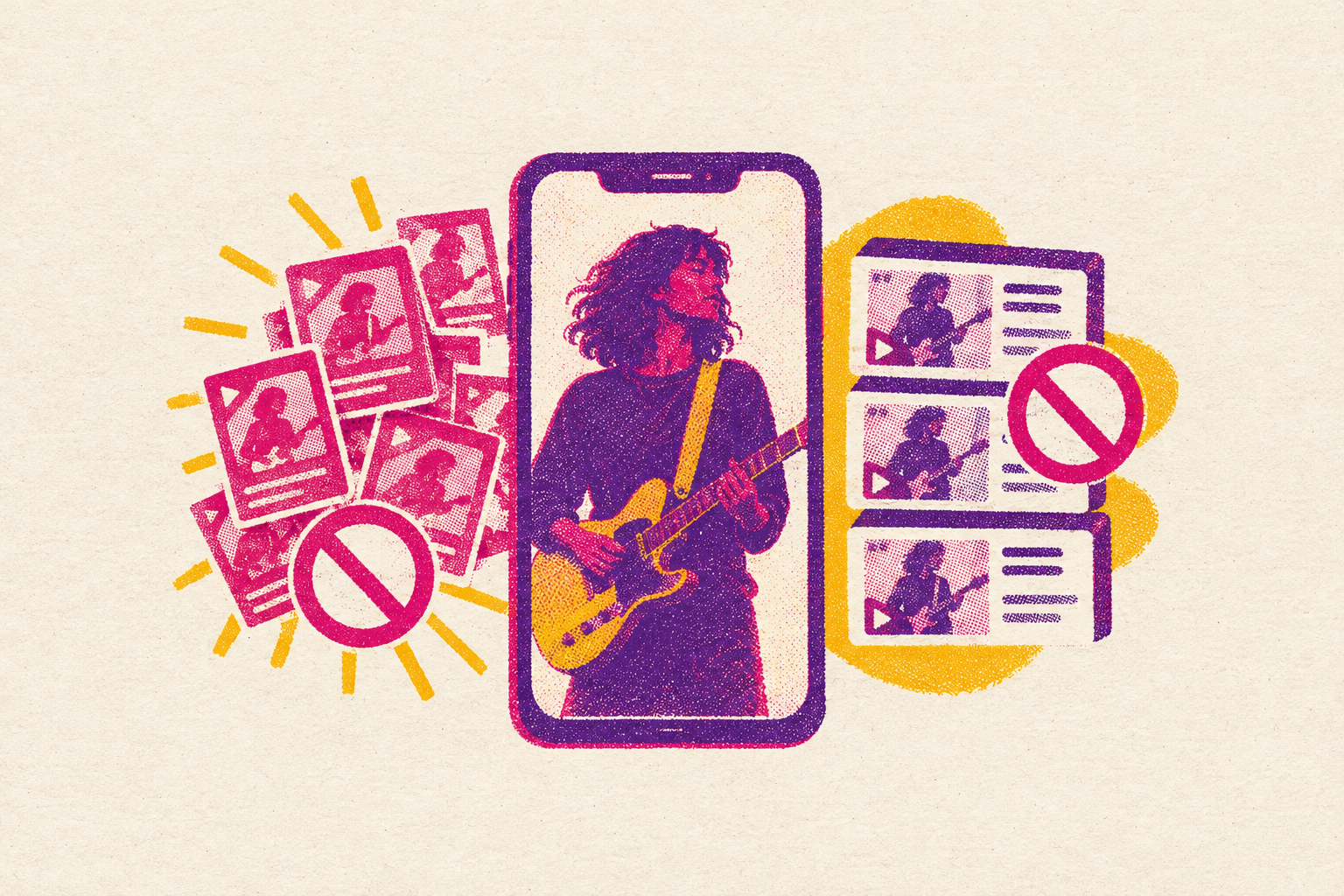
TikTok’s spam and duplicate content rules distinguish between content that breaks the rules and content that does not qualify for recommendation. For musicians, that distinction makes it possible to keep posting across multiple accounts. The workable strategy is not to distribute identical files more widely, but to give the same song distinct creative treatments that can reach different audiences and lead listeners toward streaming.
What TikTok's spam and duplicate content rules actually say
The fear that “I’ll get banned for reposting” does not match TikTok’s published originality rule. TikTok’s guidelines state, “Content is also ineligible for the FYF if it includes unoriginal or reused material without anything new”. The published rule imposes a recommendation restriction, with no automatic ban or strike for a “duplicate content penalty”. The video can remain on the platform. For You feed ineligibility leaves it findable through search and the creator’s profile page, even though it loses access to a major source of discovery.
That distinction also separates originality decisions from account strikes. TikTok issues strikes for content removals, and those strikes expire 90 days after issue. FYF ineligibility is a separate action with no strike and no stated expiry timeline. Account standing can be restored automatically, so restricted recommendation is not necessarily a permanent mark. However, the strike expiry period is not a timetable for restoring distribution.
How TikTok's detection system actually identifies a duplicate
TikTok does not publish a numbered model of its duplicate-detection system. A precise claim that it scans three layers simultaneously would therefore overstate what its public documentation establishes. It helps to distinguish between visual similarity, audio similarity, and technical or behavioral repetition. These types of similarity help explain why a slight edit may leave substantial sameness intact.
A new crop does not make everything new. If the soundtrack and most of the footage remain unchanged, the upload still shares substantial material with the earlier version. Reposting the exact lyric video file to a second account adds even less that is new. TikTok’s listed examples of unoriginal material include clips showing someone else’s watermark or logo and short clips made only from GIFs. Those examples do not make an artist’s own re-cut footage automatically unoriginal, but ownership alone does not establish that a repeat upload adds anything.
Cross-platform posting presents a different question from repetition inside TikTok. Platforms cannot see each other’s post histories, so posting a clean export elsewhere does not by itself show TikTok where it has been posted. The visible file is the practical concern. A watermark can identify a recycled platform download without any exchange of posting records.
The one cross-platform risk that is real: watermarks
Instagram suppresses videos bearing a watermark from another platform. A TikTok watermark appears when a creator downloads a video from TikTok’s app, while the original export from the editor remains watermark-free. That makes the problem avoidable at the production stage. Removing signs of recycling later is less useful than retaining a file that never acquired them.
For musicians distributing across TikTok, Reels, and Shorts, the practical approach is to export the clean file before posting anywhere and upload it natively to each platform. Audio needs separate attention. TikTok’s audio licenses do not transfer to Meta, so using TikTok sounds on Instagram Reels can limit distribution there regardless of watermark removal. For a TikTok-to-Instagram-to-Spotify funnel, the foundation is one retained master export, with each platform upload treated as a fresh native post.
What TikTok's spam clause covers for multi-account posting
Within TikTok, multiple accounts are explicitly permitted. TikTok’s guidelines state, “You can have multiple accounts—for example, for fan content or creative expression—but not to deceive others or break the rules”. The spam clause names “Using automation to run many accounts or send repetitive content”. Permission to operate fan pages or accounts for different creative purposes is not permission to automate repetitive distribution.
Circumvention is a separate and more direct prohibition. TikTok prohibits spreading violative content across accounts and using another account “to avoid restrictions”, including comment blocks or FYF ineligibility. The September 24, 2026 version added that bans can extend to “associated accounts”. A second account is therefore not a workaround for an enforcement decision. Its legitimate creative purpose does not authorize using it to escape a restriction imposed elsewhere.
By contrast, accounts serving different niches, publishing different content, or testing different hooks are not themselves named in the spam or circumvention lists. The same distinction applies to scheduling tools. A scheduler that sends the same unedited file to five accounts on a fixed pattern looks like automation used to send repetitive content. A scheduler that posts different creative packages represents a different use of the tool, with scheduled posts still subject to the rules.
Why identical posts underperform across accounts even when they're technically allowed
An identical file gives the recommendation system less reason to test the same asset again after it has already been evaluated. Posting from a second account does not always reset those audience signals. The practical weakness is diminishing discovery value, rather than an automatic punishment attached to every repost.
Audience overlap compounds that weakness. Two accounts in the same niche publishing the same video compete for similar viewers, and the second upload can reach people who already swiped past the first. The account name has changed, but the viewing proposition has not. That leaves little reason to expect a different response from the same audience.
TikTok’s guidelines describe account-level recommendation restrictions for accounts that repeatedly publish content ineligible for the FYF, even when that content does not otherwise break the rules. People can still find a restricted video through search or the profile, but those routes do not take the place of the For You feed in reaching new listeners.
What to vary across accounts so each post reads as a distinct native upload
A variation matrix keeps the underlying idea intact while changing the first three seconds, caption, hook, thumbnail, sound choice, posting time, and call-to-action. Each account then presents a different reason to watch. Each account shares the same song in a way that fits the people it is trying to reach.
The opening frame deserves the most attention. How the first viewers respond helps TikTok decide whether to keep showing a post, so a different opening shot, text treatment, or hook gives it something new to test. For a lyric video or beat cut, one version might open with a verse hook, another with a chorus drop, and another with a spoken line. Different cover frames reinforce those distinctions.
Captions and hashtags should support the same separation. Niche-specific or localized phrasing, different hashtag sets, and distinct calls-to-action reduce the repetition of identical copy across accounts. A caption built around a mood gives people a different way into the song than one that tells a story or asks fans to respond. Sound choice also supplies native context. Selecting a TikTok sound in-app differs from attaching the same non-native audio to every upload, while original music can be uploaded as a fresh original sound per account.
Timing and account capacity complete the approach. Staggering publication by account age, niche, and time zone reduces the pattern of the same asset appearing in the same window. The practitioner guidance for artists is two to five accounts that can be genuinely maintained. That range is a creative-capacity guideline intended to leave each account enough room to publish distinct hooks and formats.
Format decisions that determine whether a lyric video or beat cut counts as original
TikTok’s Creator Academy defines unoriginal content, as restated 26 September 2026, as material “largely repurposed from another source without adding any creative edits” or “combined from multiple sources with little or no additional information and/or content value”. The emphasis is on additive value. A lyric video or beat cut can add that value through care in how the visuals are arranged and timed. Using the artist’s own song, though, does not by itself make either format original.
The brat aesthetic illustrates how text can become the creative treatment. It uses lowercase, blurry Arial Narrow text on a lime green (#8ACE00) background, synchronized to the beat. The Single Word variant presents one word at a time, full screen, and is better suited to TikTok and Reels. The Line variant works better for YouTube long-form, where viewers take in longer chunks. Format choice changes how the lyric is encountered.
Short lines make that treatment easier to read. Four to eight words per line keep hooks punchy, while emotional one-liners offer a more immediate entry point than dense verses. A lyric that lands within three seconds can work as a visual hook independently of the audio. Because feeds often begin muted, the text needs to establish the message before the sound joins. Beat-synced typography gives the opening a function beyond decorating the song.
Hard cuts between track titles, high-contrast colors changing on every beat, and bold animated text turn musical timing into a visible structure. The strongest practical constraint remains readability. Short, punchy text lets the viewer follow the rhythm without having to decipher a dense screen. These treatments suit TikTok and Reels because the visual change is part of the musical presentation.
Reusing a format is different from reusing an unchanged export. The low-originality risk occurs when the same template, font, color, and file recur across posts or accounts without a new visual or audio treatment. A familiar aesthetic can support distinct creative work, but it cannot substitute for that work.
How consistent multi-account posting connects to Spotify growth, not just TikTok views
The purpose of multiple accounts is to give a song more chances to reach an audience that will act on the discovery. TikTok distributes audio through content categories as well as artist followings. Reaching the right seed audience can therefore lead to more playlist adds and streams as well as more TikTok followers. Views are an intermediate result.
TikTok’s Add to Music App feature makes that connection tangible. Launched in November 2023, it had driven more than a billion track saves across streaming services by mid-2025. That figure shows how people can go straight from finding music to saving it, though it does not promise that every post will lead to streams. Publishing a snippet before the full song lets musicians test where retention and comments spike, then build the release around the strongest moment.
Consistency supports those tests better than account proliferation. Chartlex campaign data found that independent artists who posted short-form video content at least three times per week had 2.5x higher Spotify profile visits from external sources than those who posted once a week or less.
TikTok supports discovery through short hooks, fast iteration, and sound-led content, while Instagram develops trust through a consistent presence and deeper fan signals. Spotify provides listening depth through algorithmic playlists, monthly listeners, and pre-saves. Understanding the rules makes consistent, intentional posting possible, and that intentional posting is what moves the strategy toward streams. Beyond those platforms, email subscribers, Discord members, and Patreon supporters give artists a way to build ties with fans that last longer and rely less on what algorithms show people.